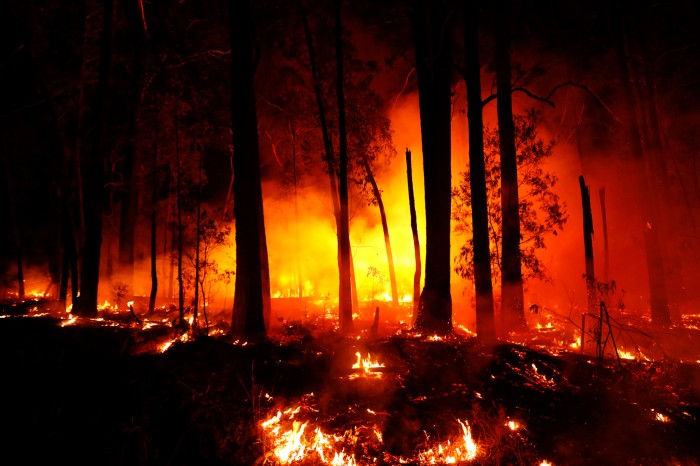
A INFO ABOUT AUSTRALIA BUSHFIRE

Image result for bush fires australia
A RANDOM PICTURE OF BUSHFIRES

Australia is the world’s driest continent, and drought and bushfires are regular occurrences that, sadly, are a natural part of Australia’s weather cycle. Australia has a history of severe bushfires. Such tragedies as the Ash Wednesday fires of February 1983 (71 deaths in Victoria and South Australia), the Tasmanian fires of February 1967 (62 lives, more than 1400 houses and buildings lost) and the New South Wales bushfires of 1994, place bushfires high on the list of Australia’s natural disasters. But for now let’s look at the huge bushfire occurred in 16th February 1983 (Ash Wednesday Bushfires).
             It was April 1982 to January 1983 in Victoria; the weather condition through these days was severe drought conditions and little rainfall, resulting in its driest period on record. A combination of dry grasslands and forests, very hot temperatures, low humidity and high wind gusts presented Victoria with a high bushfire risk. The temperature was 43 degrees Celsius on Ash Wednesday (16 February 1983), which caused huge bushfires that damaged/destroyed 2545 Building/house and huge amount of trees throughout the regions in Victoria.
             Also lots of lives got lost from fire. 75 (15 lives lost from firefighter) in total lives from fires, (47 lives in Victoria and 28 in South Australia) and there were hundreds of people injured due to their skin burnt.
             There were many other causes for fires including, clashing of electric power lines, tree branches connecting with power lines, fires being deliberately lit, and of course the weather. The fire started in Victoria at Cudgee and Branxholme and then the fire also started around Mount Macedon, Dandenong Range Cockatoo, Upper Beaconsfield and Belgrave Heights, Monivae, Branxholme, Warburton and in the Otways. The Fires were so big that it also spread around South Australia through Adelaide Hills and in farming country in the south east of the state.

A RESEARCH ABOUT “CORONAVIRUS” IN HONG KONG

Image result for coronavirus in hong kong
protests meet coronavirus

A chinese professors across the globe are becoming increasingly vocal about the handaling of the coronavirus outbreak. Yuen Kwok – Yung, a world-renowned microbiologist, became the first expert to call the Hong Kong situation a “community outbreak” and warned that the city could become the “next Wuhan”. He told that Time Higher Education that he was driven by his conscience and concern for public well- being. When control measures or public response do not go according to scientific evidence, we as a public should speak out.

Other than that, Mr Jeremy Lim, a partner at global consultancy firm Oliver Wyman’s health and life sciences practice, said that more developed nations tend to have better detection and reporting of cases, more “sophisticated” contact tracing, and a wider availability of test kits. It gave people “very concrete actions” that handed back measure of control to people whose sense of control will feel threatened.

Besides that, Chief Executive has also backed down from a plan to offer free treatment in the city to mainlanders and anyone else needing hospitalisation because of the coronavirus. They also giving a face mask for free to everyone to safe as much as can. There are thousands of medical workers went on strike in the city last week to demand a complete ban on entries from mainland China, worried that hospitals would be overwhelmed by new cases as mainland Chinese sought to use Hong Kong’s healthcare system. There have also been protests against the use of certain housing estates as potential quarantine facilities. Various moves by the government in relation to the coronavirus have also exacerbated the situation.

IS THAT CAPITAL PUNISHMENT PROTECTS THE PUBLIC AND DISCOURAGES CRIME ?

Image result for capital punishment

Capital punishment or the death penalty is a legal process whereby a person is put to death by the state as a punishment for a crime. The judicial decree that someone be punished in this manner is a death sentence, while the actual enforcement is an execution. The manner of execution is different from one country to the next, but in all cases, the end result is the same. Death penalty is actually a part of criminal law. Worldwide there are arguments for or against death penalty. Both the arguments have their own justification.

 I agree that capital punishment protects the public and discourages crime because the death penalty prevents future murders. Society has always used punishment to discourage would be criminals from unlawful action. Since society has the highest interest in preventing murder, it should use the strongest punishment available to deter murder and that is the death penalty. If murderers are sentenced to death and executed, potential murderers will think twice before killing for fear of losing their own life.

 Furthermore, a just society requires the death penalty for the taking of a life. When someone takes a life, the balance of justice is disturbed. Unless that balance is restored, society succumbs to a rule of violence. Only the taking of the murderer’s life restores the balance and allows society to show convincingly that murder is an intolerable crime which will be punished in kind. Retribution has its basis in religious values, which have historically maintained that it is proper to take an ‘eye for an eye’ and a life for a life. Offenders deserve the worst punishment under our system of law and that is the death penalty.

 Besides that, the death penalty can provide a deterrent against violent crime. When many criminologists define  deterrence in terms of the death penalty, they are looking at how the presence of this sentencing can stop violent acts by preventing someone to commit them in the first place. It becomes a value proposition. Capital punishment creates an irreversible deterrent that the murderer will never get the chance to take a life again. It is a form of incapacitation that helps to protect society by preventing future crime in this matter.

 Next, it doesn’t need to be carried out with brutatily. At various points in history, the death penalty was carried out by beheading, stoning, crucifixion, electrocution, shooting or hanging will scare the criminals and preventing future crime.

 Finally, it eliminates the possibility of an escape and future victims. When there is a life in prison sentence, then an individual has nothing to lose with their effort to escape. What can the criminal justice system do to that person except add more time to their life sentence ? By using capital punishment this threat disappears which means there will be no future victims either.

 In conclusion, these are only some among the many advantages provided by the propenets of the death penalty law. Death penalty help to curtail future murderers thus, can save more lives, more inocent lives. That there’s God who will judge each one on Earth with fairness and equality. If we are only God fearing and morally upright, responsible enough to know consequences of our actions, no penalty of any sort is necessary.

ITS ABOUT CURFEW

Image result for curfew

 Curfew for teens is a highly debated issue that raises the concerns of many people in the modern day society. The curfew of teens refers to the putting of time restriction for the children who are in their teenage years by their parents and guardians. Many counsellors and experts in children upbringing advocate for curfew for teens due to the many benefits it impacts to the society.

 In the first place, curfews help teenagers to stay away from bad influences. Moreover, bad influences are everywhere, and those who are unaware of them are particularly susceptible to their impact. This can lead to poor choices, toxic lifestyles and unhappiness in general to maintain a safe and healthy distance from harmful people and things. For example if a teen gets an invite to a party that will last all night from a very attractive peer. As a normal teen, he does not want to pass this chance up but also remembers that his or her parents have enforced a strict 9pm curfew. But the party starts at 8pm, so now the teen has to choose between going to the party but only for awhile or not caring about the curfew. If the teen is rational enough, he or she will obey the curfew because a moment of pleasure is not worth a lifetime of suffering.

 In addition, curfews keep family together. The reason is curfews can make the teen to be at home exactly on time rather than hanging around on the streets. Teens enable to spend their free time with family members which can keep them always attached to their family members. For example, playing carom with family members, cooking together can keep the family members always together. Hence, curfews can keep the family together and also can create a very good bond between family members.

 Moreover, curfews can make teens feel safe. Teens do not have to worry about anything and about anyone. They can be more safe in their home and out of troubles. Regarding to Dr. Sundramoorthy in Star newspaper, curfews can minimize the possibility of young people getting into dangerous situations and also it is being implement in many develop countries. They can even produce good results in their exam by doing revision at night and also can do something productive. To illustrate, if teens practice curfews in their daily life they can’t be able to involve in those kind of negative activities as robbery, snatching and more. This will make their parents doesn’t have to worry about their children.

 Besides that, curfews can help to build a structure in teen’s life. As a teenager it is the turning point in their life where the biological changes happen between the ages 13 to 18. The decision that they made in this age will defined their future. Curfews can bring the teenager to the positive ways. This is because, teenager will able to move in more positive ways when they are in their home. For instance, they will be more responsible about their belongings, more helpful to their family members and pray well. Teens can build up their positive actions day by day and for sure they will carry forward their daily activities once grown up then.

 In conclusion, proving that curfews are effective plus does not keep teens out of trouble. Although, trouble does not have a particular time frame, however it is well known that majority of negative activities are all carried out under the moon light, nothing good happens after midnight. We can’t deny that minimizing the spare time teenagers posses to hang out rather late at night, roaming around the streets is an effective way to prevent teenagers from getting themselves into trouble and even committing crimes. Teenagers fail  to realize that curfews does not only benefit us by keeping us out of trouble, provides us with better time management skills and even offering us the chance to be independent nor responsible in life.

Design a site like this with WordPress.com
Get started